Fictional example
Example: Legacy Check of an IBM i application
A stable RPG system on IBM i, two developers close to retirement and customers who demand real-time interfaces: this fictional example shows how a Legacy Check assesses the situation and maps out a path without a big bang. You can download both parts of the report as PDFs.
The situation
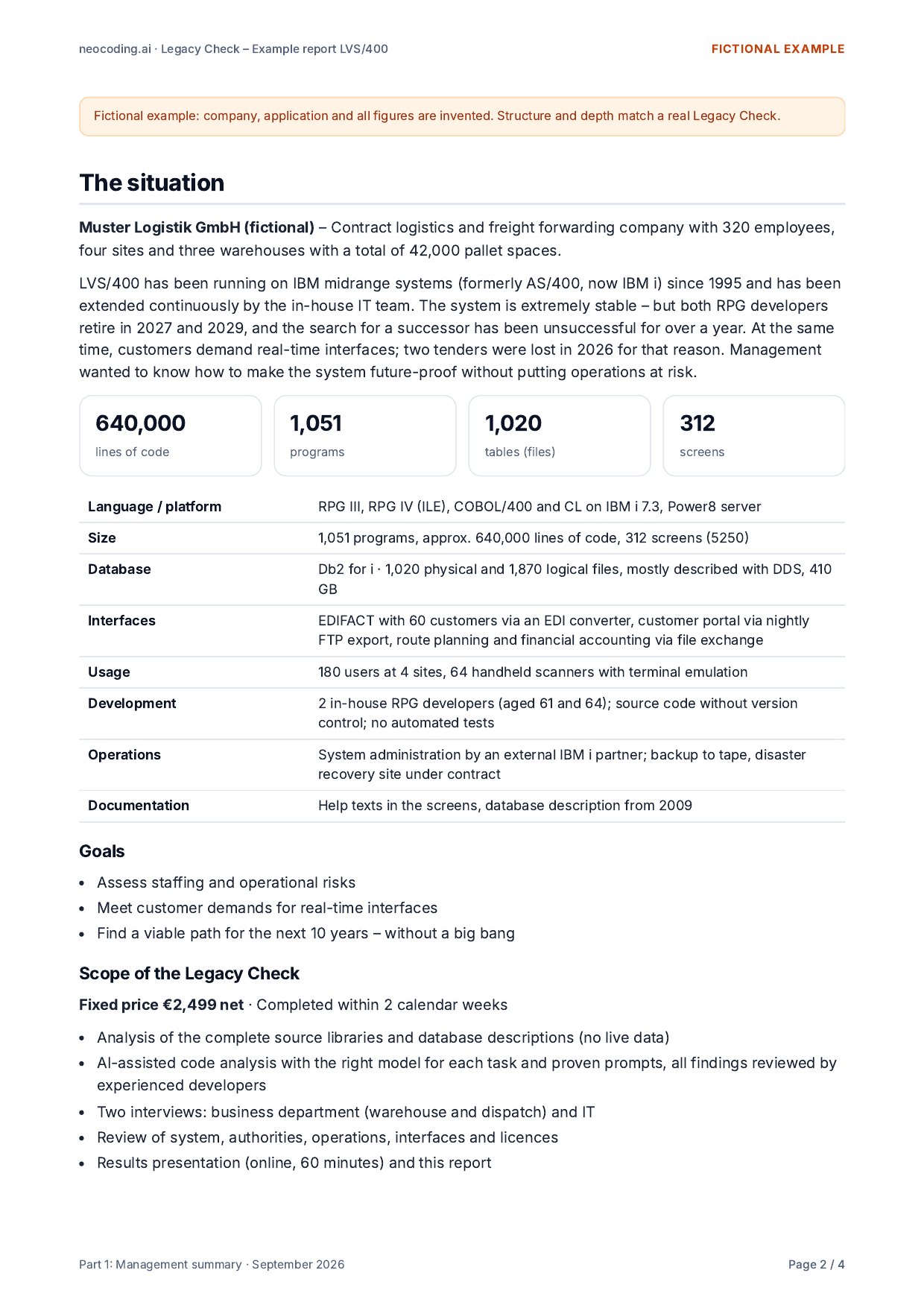
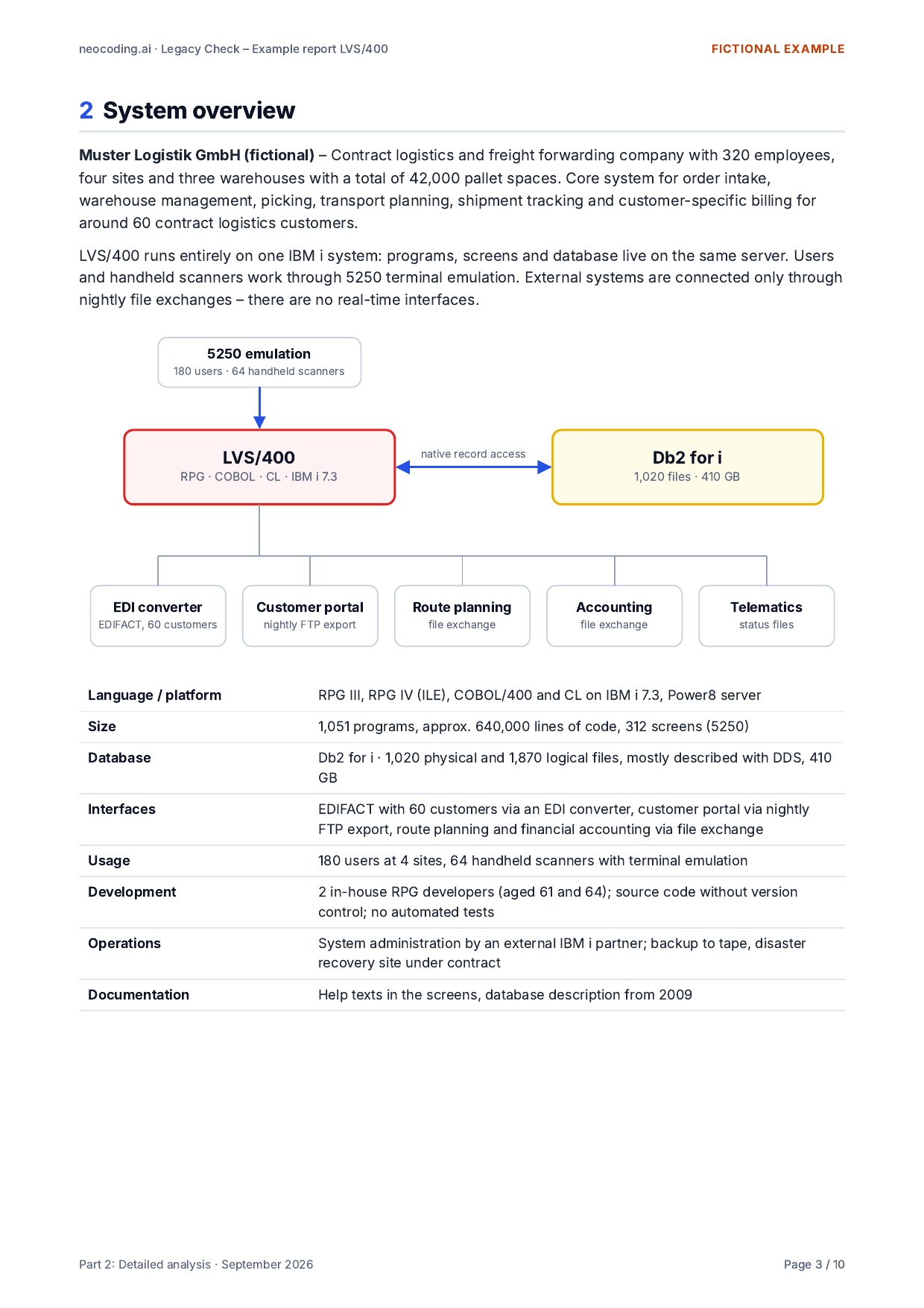
Muster Logistik GmbH (fictional) – Contract logistics and freight forwarding company with 320 employees, four sites and three warehouses with a total of 42,000 pallet spaces.
Core system for order intake, warehouse management, picking, transport planning, shipment tracking and customer-specific billing for around 60 contract logistics customers.
LVS/400 has been running on IBM midrange systems (formerly AS/400, now IBM i) since 1995 and has been extended continuously by the in-house IT team. The system is extremely stable – but both RPG developers retire in 2027 and 2029, and the search for a successor has been unsuccessful for over a year. At the same time, customers demand real-time interfaces; two tenders were lost in 2026 for that reason. Management wanted to know how to make the system future-proof without putting operations at risk.
- Assess staffing and operational risks
- Meet customer demands for real-time interfaces
- Find a viable path for the next 10 years – without a big bang
Scope of the Legacy Check
Fixed price €2,499 net · Completed within 2 calendar weeks
- Analysis of the complete source libraries and database descriptions (no live data)
- AI-assisted code analysis with the right model for each task and proven prompts, all findings reviewed by experienced developers
- Two interviews: business department (warehouse and dispatch) and IT
- Review of system, authorities, operations, interfaces and licences
- Results presentation (online, 60 minutes) and this report
The result
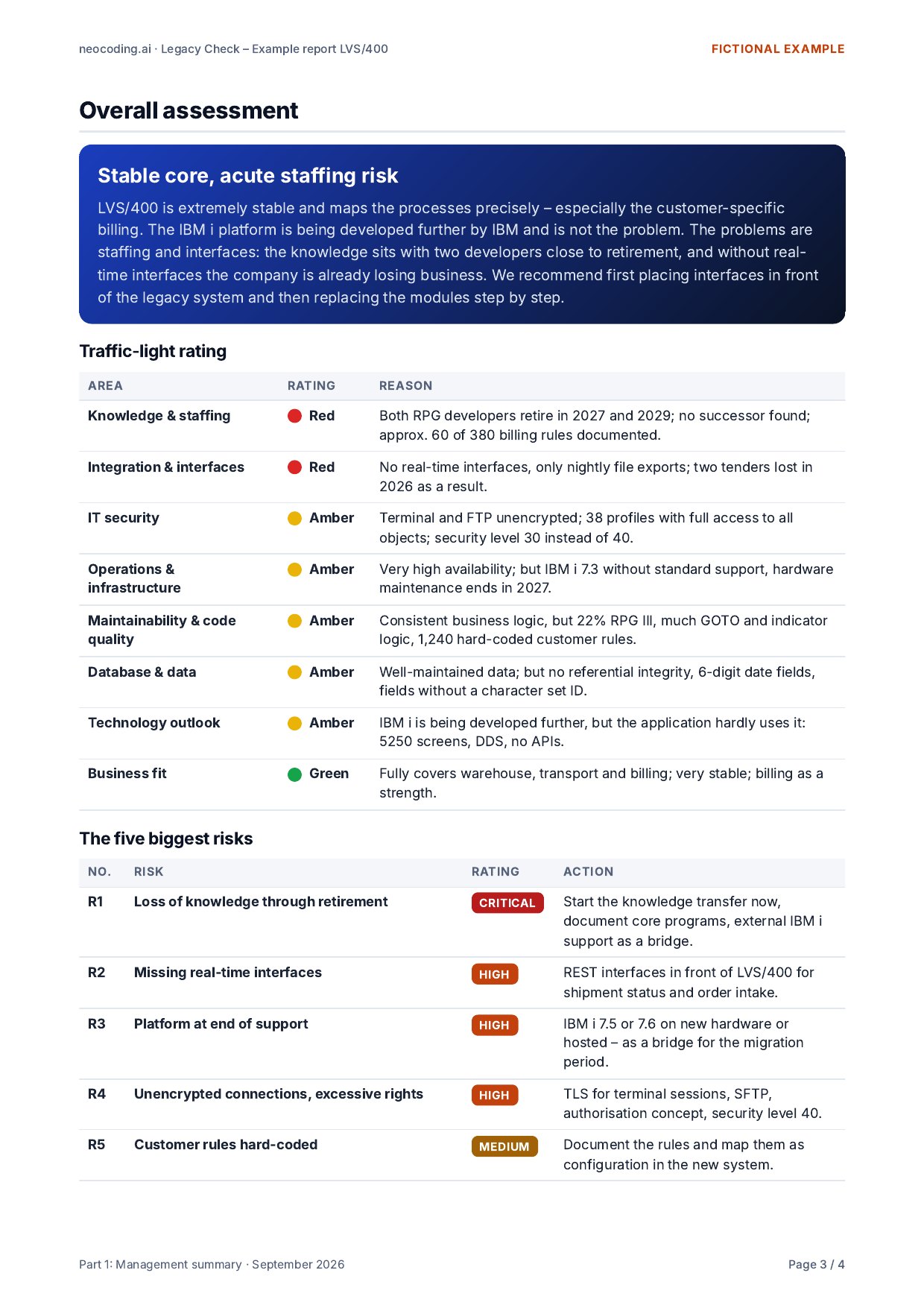
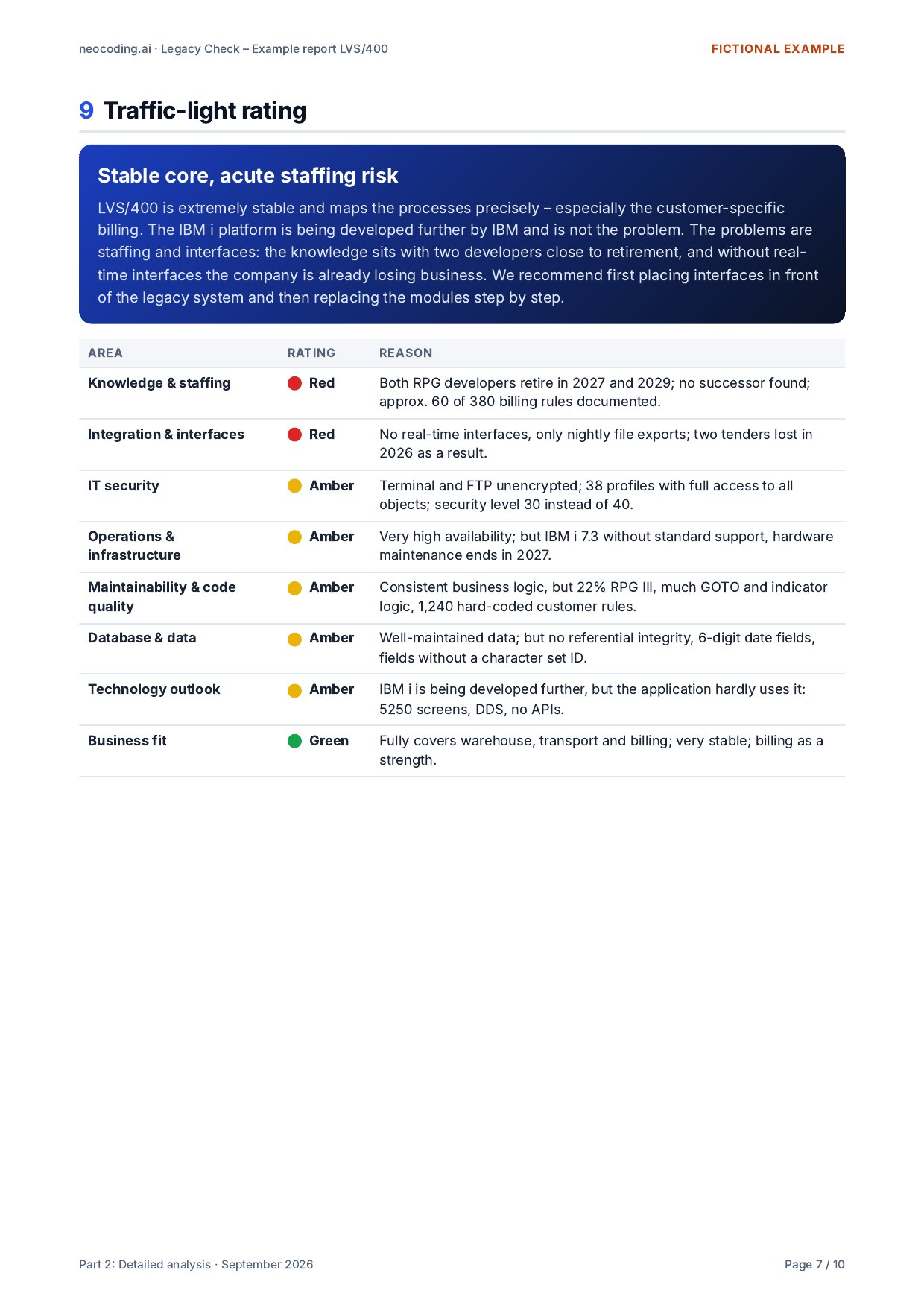
Stable core, acute staffing risk
LVS/400 is extremely stable and maps the processes precisely – especially the customer-specific billing. The IBM i platform is being developed further by IBM and is not the problem. The problems are staffing and interfaces: the knowledge sits with two developers close to retirement, and without real-time interfaces the company is already losing business. We recommend first placing interfaces in front of the legacy system and then replacing the modules step by step.
Traffic-light rating
The five biggest risks
| No. | Risk | Rating | Action |
|---|---|---|---|
| R1 | Loss of knowledge through retirementBoth RPG developers retire in 2027 and 2029. Knowledge of around 380 billing rules and 1,051 programs is barely documented. | Critical | Start the knowledge transfer now, document core programs, external IBM i support as a bridge. |
| R2 | Missing real-time interfacesCustomers demand shipment status and order intake via API; today there are only nightly file exports. | High | REST interfaces in front of LVS/400 for shipment status and order intake. |
| R3 | Platform at end of supportIBM i 7.3 no longer has standard support; hardware maintenance for the Power8 server ends in 2027. | High | IBM i 7.5 or 7.6 on new hardware or hosted – as a bridge for the migration period. |
| R4 | Unencrypted connections, excessive rightsTerminal sessions (Telnet) and FTP are unencrypted, including over the warehouse Wi-Fi; 38 profiles have full access. | High | TLS for terminal sessions, SFTP, authorisation concept, security level 40. |
| R5 | Customer rules hard-coded1,240 places with hard-coded customer rules; every new customer requirement needs a program change. | Medium | Document the rules and map them as configuration in the new system. |
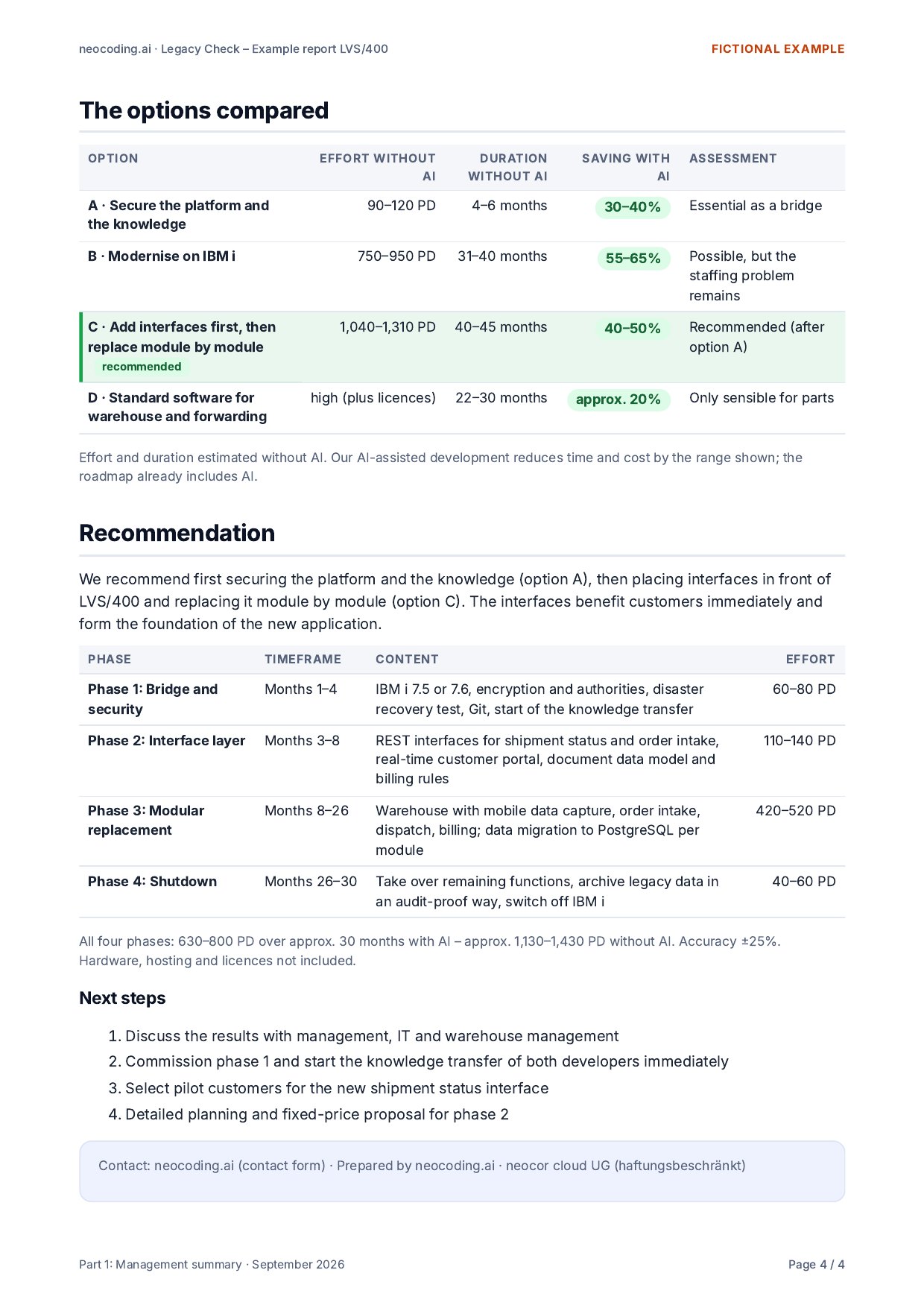
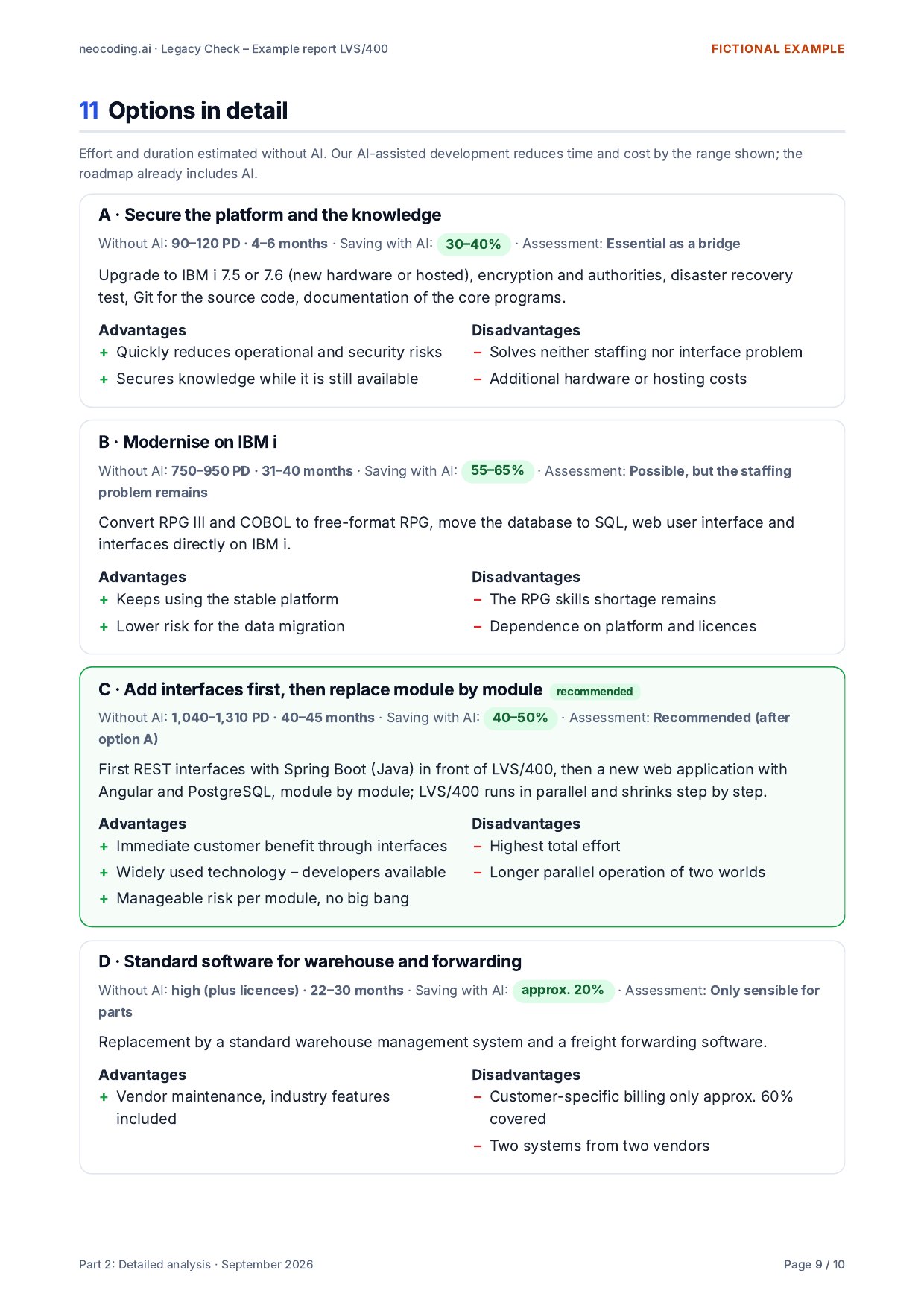
The options compared
| Option | Effort without AI | Duration without AI | Saving with AI | Assessment |
|---|---|---|---|---|
| ASecure the platform and the knowledgeUpgrade to IBM i 7.5 or 7.6 (new hardware or hosted), encryption and authorities, disaster recovery test, Git for the source code, documentation of the core programs. | 90–120 PD | 4–6 months | 30–40% | Essential as a bridge |
| BModernise on IBM iConvert RPG III and COBOL to free-format RPG, move the database to SQL, web user interface and interfaces directly on IBM i. | 750–950 PD | 31–40 months | 55–65% | Possible, but the staffing problem remains |
| CAdd interfaces first, then replace module by modulerecommendedFirst REST interfaces with Spring Boot (Java) in front of LVS/400, then a new web application with Angular and PostgreSQL, module by module; LVS/400 runs in parallel and shrinks step by step. | 1,040–1,310 PD | 40–45 months | 40–50% | Recommended (after option A) |
| DStandard software for warehouse and forwardingReplacement by a standard warehouse management system and a freight forwarding software. | high (plus licences) | 22–30 months | approx. 20% | Only sensible for parts |
Effort and duration estimated without AI. Our AI-assisted development reduces time and cost by the range shown; the roadmap already includes AI.
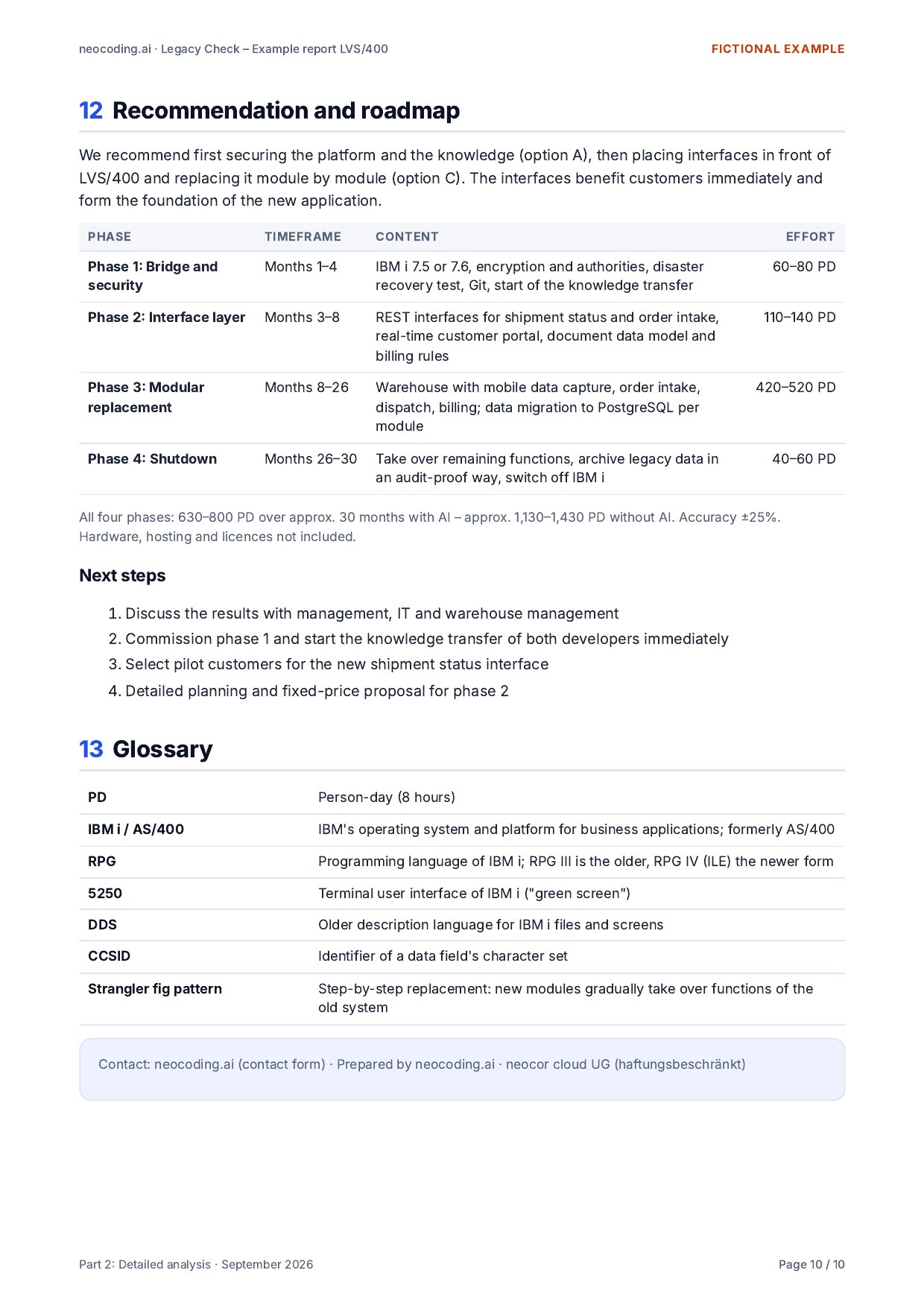
Recommendation and roadmap
We recommend first securing the platform and the knowledge (option A), then placing interfaces in front of LVS/400 and replacing it module by module (option C). The interfaces benefit customers immediately and form the foundation of the new application.
- Phase 1
Bridge and security
Months 1–4 · 60–80 PD
IBM i 7.5 or 7.6, encryption and authorities, disaster recovery test, Git, start of the knowledge transfer
- Phase 2
Interface layer
Months 3–8 · 110–140 PD
REST interfaces for shipment status and order intake, real-time customer portal, document data model and billing rules
- Phase 3
Modular replacement
Months 8–26 · 420–520 PD
Warehouse with mobile data capture, order intake, dispatch, billing; data migration to PostgreSQL per module
- Phase 4
Shutdown
Months 26–30 · 40–60 PD
Take over remaining functions, archive legacy data in an audit-proof way, switch off IBM i
All four phases: 630–800 PD over approx. 30 months with AI – approx. 1,130–1,430 PD without AI. Accuracy ±25%. Hardware, hosting and licences not included.
Download the report
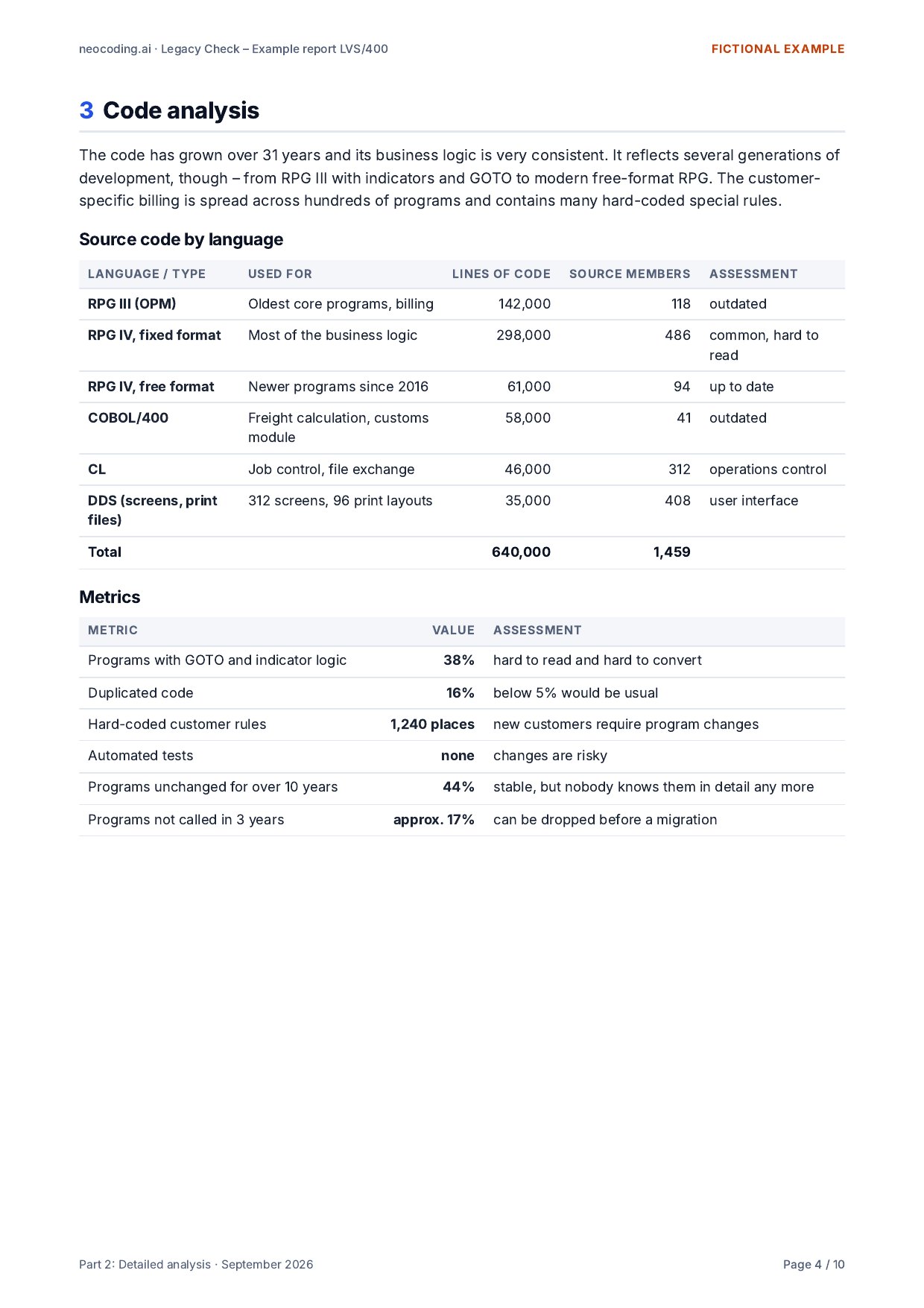
The report has two parts: a compact summary for management and a detailed analysis for IT. Click a page to enlarge it.
Part 1: Management summary
Download PDF
Part 2: Detailed analysis
Download PDF
More example reports
Every application is different – and so is the right path. These fictional examples show the Legacy Check for other technologies.
-
.NET 4.8 · VB.NET · SQL Server
.NET 4.8 application in manufacturing
VB.NET and SQL Server: remove security risks, keep valuable business logic and modernise the technology.
-
Delphi 7 · Firebird
Delphi inventory system at a wholesaler
Delphi 7 and Firebird: e-invoicing obligation, knowledge monopoly and step-by-step replacement with a web application.
Your own Legacy Check
Fixed price €2,499 net, results usually within two weeks – with a report, a results presentation and a concrete recommendation for your application.